Guide · filter
What an air purifier actually fixes (and what it can't)
A HEPA purifier is an honest machine: it removes particles — smoke, pollen, dust, dander — from the air it moves. It does not touch CO₂, and no marketing changes that physics.
Fixes / doesn't fix
| Problem | Purifier helps? | What actually works |
|---|---|---|
| Wildfire smoke, PM2.5 | Yes — its best event | HEPA sized right (CADR tool), windows closed |
| Pollen, dust, dander | Yes | Run continuously on low in the bedroom |
| Cooking particles | Yes, partly | Range hood first (vented), purifier as mop-up |
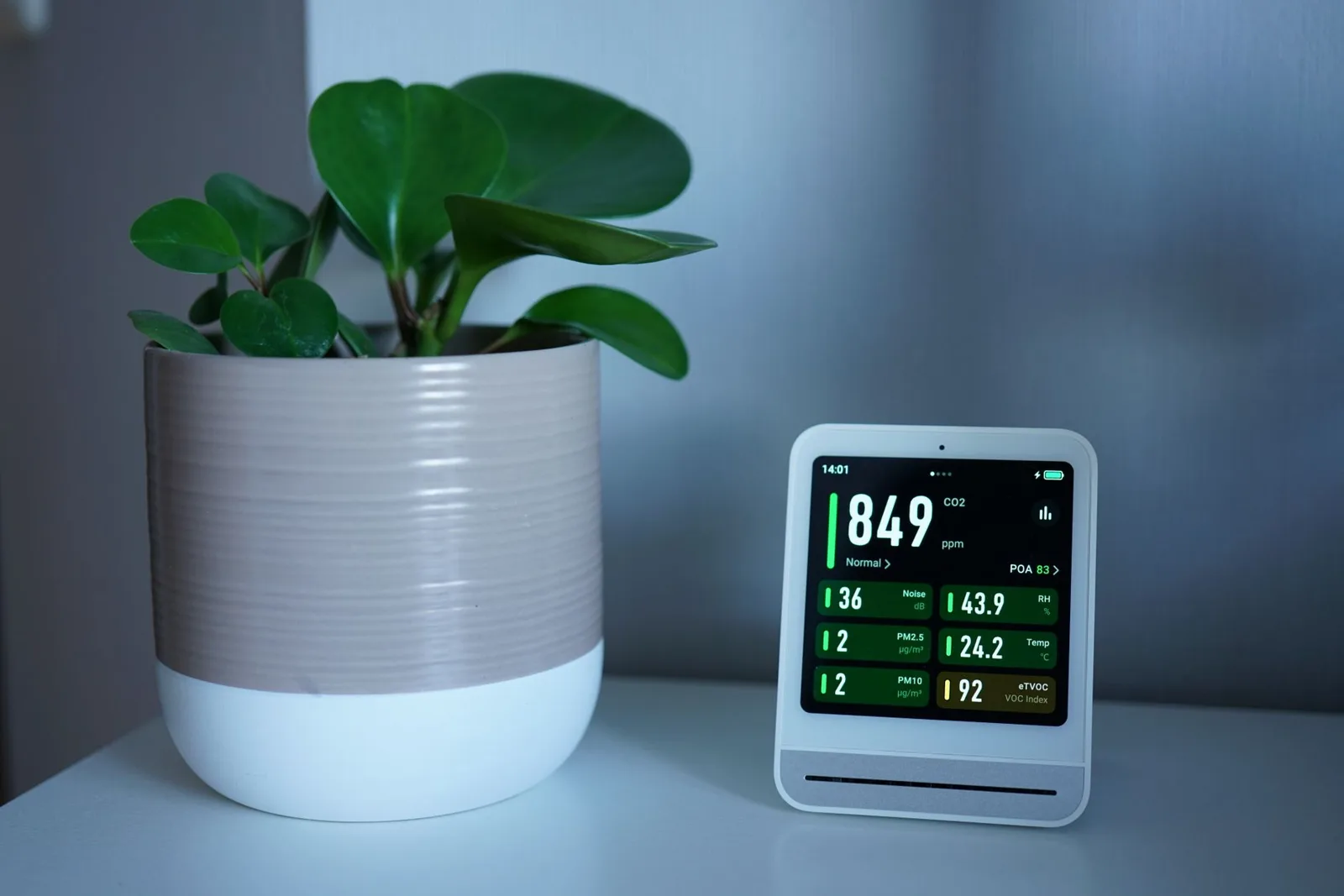
| Stuffiness, sleepiness, CO₂ | No | Ventilation — a $0 window beats a $600 machine |
| Odors & VOCs | Only with serious carbon | Kilograms of activated carbon help; thin “odor” pads are cosmetic. Ventilation and source removal work better |
| Viruses | Partly | Filtration lowers airborne dose; it’s a layer, not a shield — ventilation is the other layer |
Buying without regret
- Size by smoke CADR, not by marketing "room size" — the calculator takes a minute.
- True HEPA (H13 or "99.97% at 0.3 µm"), not "HEPA-type" or "HEPA-like."
- Check filter prices before buying the machine — the filter is the real product; some brands sell cheap machines and expensive habits.
- Quiet matters more than max power: the purifier that's annoying gets turned off. Oversize a step, run it low.
- Skip ionizers, "plasma," UV add-ons unless certified ozone-safe — California's CARB maintains the list of certified cleaners precisely because some devices emit ozone, a lung irritant, on purpose or as a byproduct.
Quick sizing (smoke, 5 ACH, 8-ft ceilings)
| Room | Area | Smoke CADR to look for |
|---|---|---|
| Bedroom | 120 ft² / 11 m² | ≥ 80 CFM |
| Large bedroom / office | 200 ft² / 19 m² | ≥ 135 CFM |
| Living room | 300 ft² / 28 m² | ≥ 200 CFM |
| Open living area | 500 ft² / 46 m² | ≥ 335 CFM |
Different room? The calculator does yours in ten seconds.
The $40 route that actually works
A box fan + a MERV-13 furnace filter (or four, taped into the "Corsi–Rosenthal box") is a legitimate smoke-season tool — EPA researchers have tested DIY air cleaners and found they can deliver real clean air for a fraction of the price, at the cost of noise and looks. Build it in five steps:
- Buy a 20-inch box fan and four 20×20 MERV-13 furnace filters (one filter also works; four filter better and quieter).
- Tape the filters into an open-bottomed box, arrows on the filter frames pointing inward.
- Tape the fan on top, blowing up and out.
- Cardboard over the top corners of the fan face (the "shroud") adds real efficiency for free.
- Run it on medium in the room you live in; replace filters when visibly grey.
Details and test data in the smoke guide sources.
Sources
- US EPA — Air cleaners and air filters in the home.
- US EPA — Research on DIY air cleaners to reduce wildfire smoke indoors.
- California Air Resources Board — List of CARB-certified air cleaning devices (ozone safety).