Symptom · meetings
Why do I get sleepy in meetings?
Quick answer: partly biology, partly the room. A closed four-person meeting room gains on the order of a thousand ppm of CO₂ per hour, and controlled studies find thinking measurably duller right in that range.
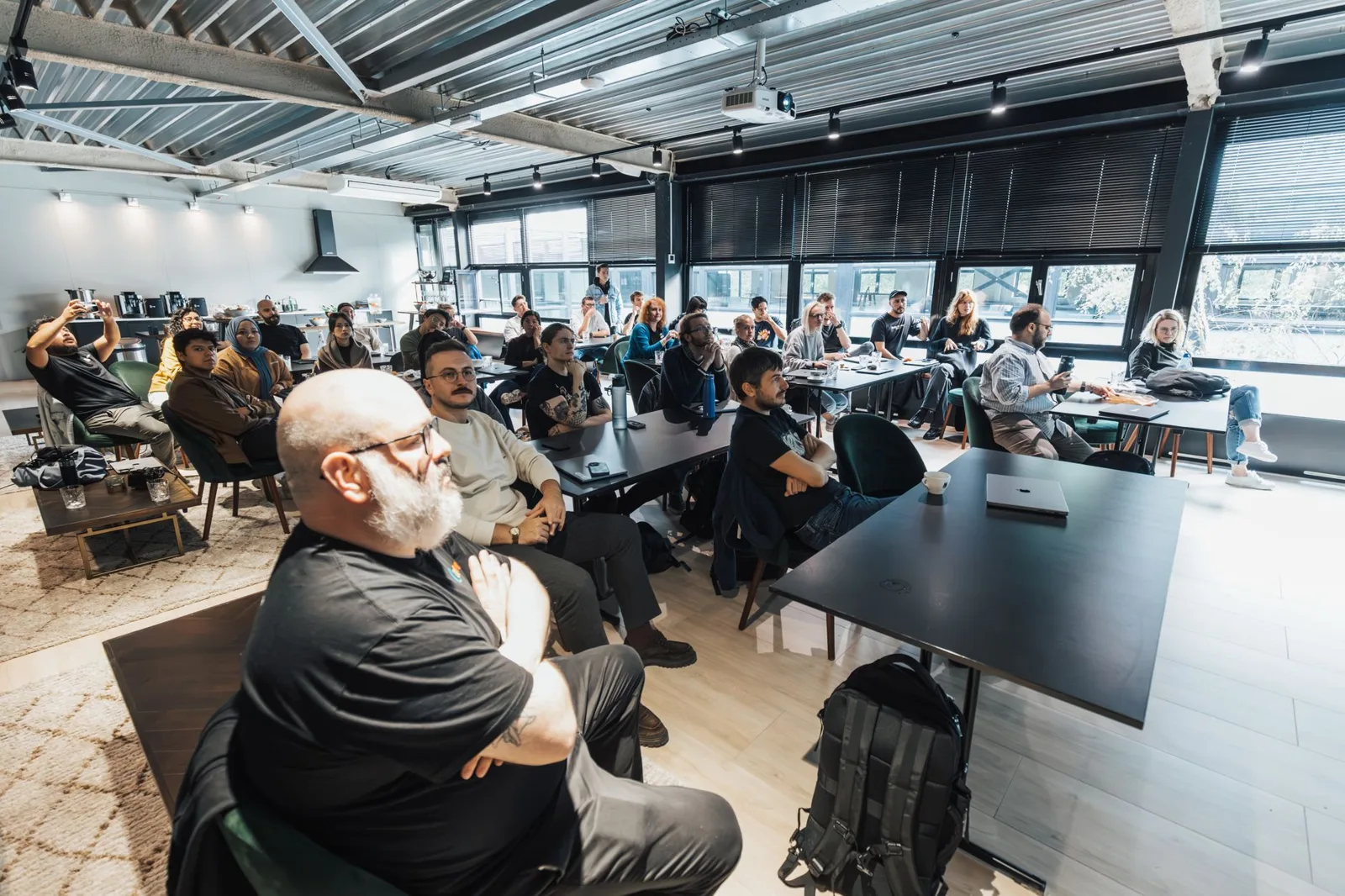
The arithmetic of a closed door
Adults doing light office work each exhale CO₂ at a steady, well-measured rate (Persily 2017 is the standard reference). Put four people in a typical 20 m² room with the door shut and negligible fresh air, and the room climbs roughly 1,000–1,500 ppm per hour — an order-of-magnitude estimate, but the order is the point. The meeting doesn't feel long because it is long; it feels long because minute forty smells like minute one, re-breathed.
Forty minutes into a small closed meeting: past the band where Satish (2012) measured decision-making declines.
What the studies measured
- Satish 2012 (EHP): at 1,000 ppm, decision-making scores dropped versus 600 ppm; at 2,500, they fell sharply — in a blinded chamber study.
- Allen 2016 (EHP, the Harvard "COGfx" study): office workers scored on average ~15% lower in ~945 ppm conditions and ~50% lower around 1,400 ppm than in a high-ventilation, low-VOC condition.
- The counterweight: Scully 2019 found astronaut-like subjects unimpaired by pure CO₂ even at 15,000 ppm. Read the two literatures together and the safe conclusion is: rooms high in CO₂ are rooms full of rebreathed everything — and people test and feel worse in them. The ppm number is your meter, ventilation is your fix.
When it's not the air
- The post-lunch dip is circadian — alertness sags in early afternoon even in perfect air. A 2 pm meeting fights biology.
- Sleep debt. Six hours of sleep makes every conference room a bedroom.
- The meeting itself. Passive listening for an hour sedates; no window fixes an agenda.
The tell: if everyone fades in that room, and revives in the hallway — suspect the room.
Fixes, cheapest first
- $0: door open, or window cracked. Cross-flow can drop hundreds of ppm in minutes.
- $0: 5-minute air break every 45 — humans and room both reset.
- $0: book the bigger room for the long meeting; volume is a CO₂ buffer.
- ~$60–250, once: put an NDIR monitor on the table. A visible number ends the "is it just me?" debate and gets facilities moving like nothing else.
Run the meeting-room test
- Baseline: bring a logging monitor to your usual recurring meeting. Don't announce it; don't change anything. Note the reading at start and end.
- Intervention: same meeting next week, door open (or window cracked) from minute one.
- Compare: end-of-meeting ppm, and — ask around — how the last ten minutes felt.
- Escalate with the graph, not with feelings: two curves side by side is a facilities ticket that writes itself.
Typical result: the closed run ends 400–800 ppm higher. If both runs stay under ~800, congratulations — your room is fine and your meetings are just boring.
Sources
- Satish U. et al. (2012), EHP. doi:10.1289/ehp.1104789
- Allen J.G. et al. (2016), EHP. doi:10.1289/ehp.1510037
- Scully R.R. et al. (2019), npj Microgravity. doi:10.1038/s41526-019-0071-6
- Persily A., de Jonge L. (2017), Indoor Air (occupant CO₂ generation rates). doi:10.1111/ina.12383